Four networks
Everything you build is joined by four things you draw on the map: power lines, water pipes, fiber and roads. Each is solved as a real network. Buildings that touch share what they have, and a line carries it between sites.
A datacenter works only when all four reach it: power to run, water (through cooling towers) to shed its heat, a fiber path to the Internet Exchange, and a road to a village street so its staff can get to work. Click any building to see which one it is missing.
Power
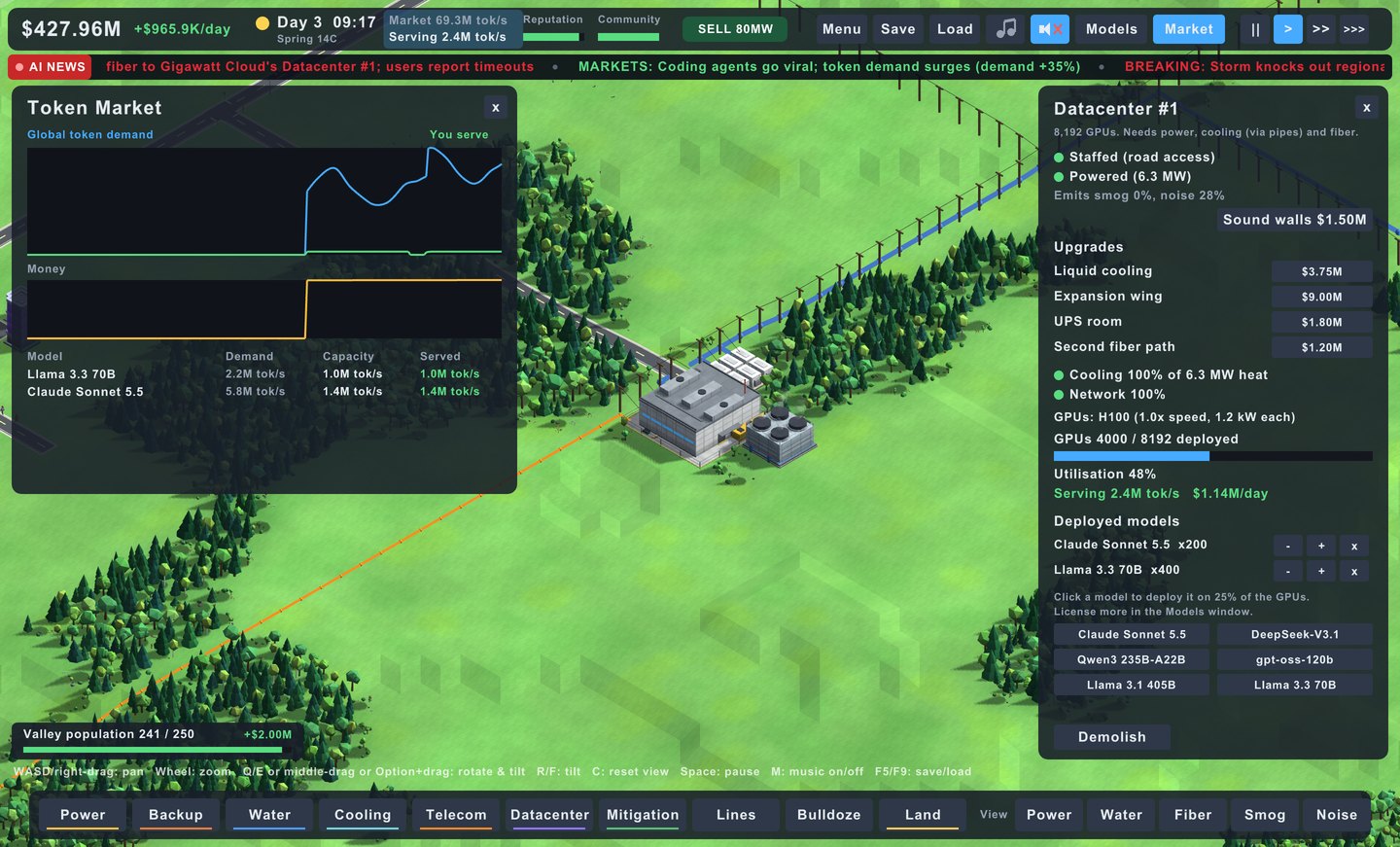
Power comes from gas, solar, wind, nuclear, hydro and geothermal plants, and from the regional grid at a price. The cleanest and cheapest sources are used first. Batteries charge from any surplus and discharge when you are short; diesel generators start only when the network can't cope.
- A network asked for more than it can supply goes dark as a whole. You get a "power is tight" warning at 92% of supply.
- Storms knock out the regional grid. A UPS room, batteries or diesel carry you through.
- Surplus power sells back to the grid, for the best price at the evening peak.
Water and cooling
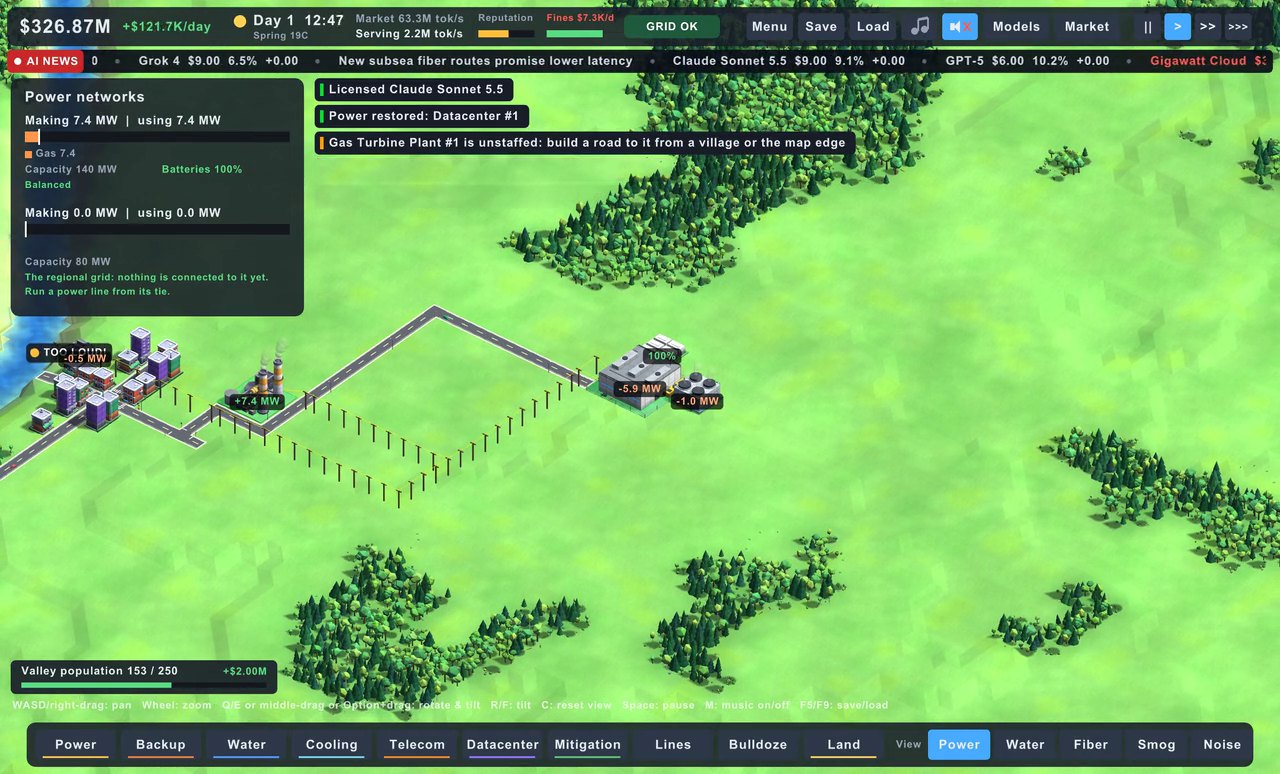
GPUs turn nearly all their power into heat. Cooling towers remove it with water pumped from the river; air chillers need no water but draw more power. Too little cooling and a datacenter throttles, then overheats.
- Heat waves sap your cooling, and droughts halve what the pumps can draw.
- A Water Reservoir banks spare water for the next dry spell.
- A Heat Exchanger sells waste heat to a nearby village as district heating, which also earns goodwill.
Models and the token market
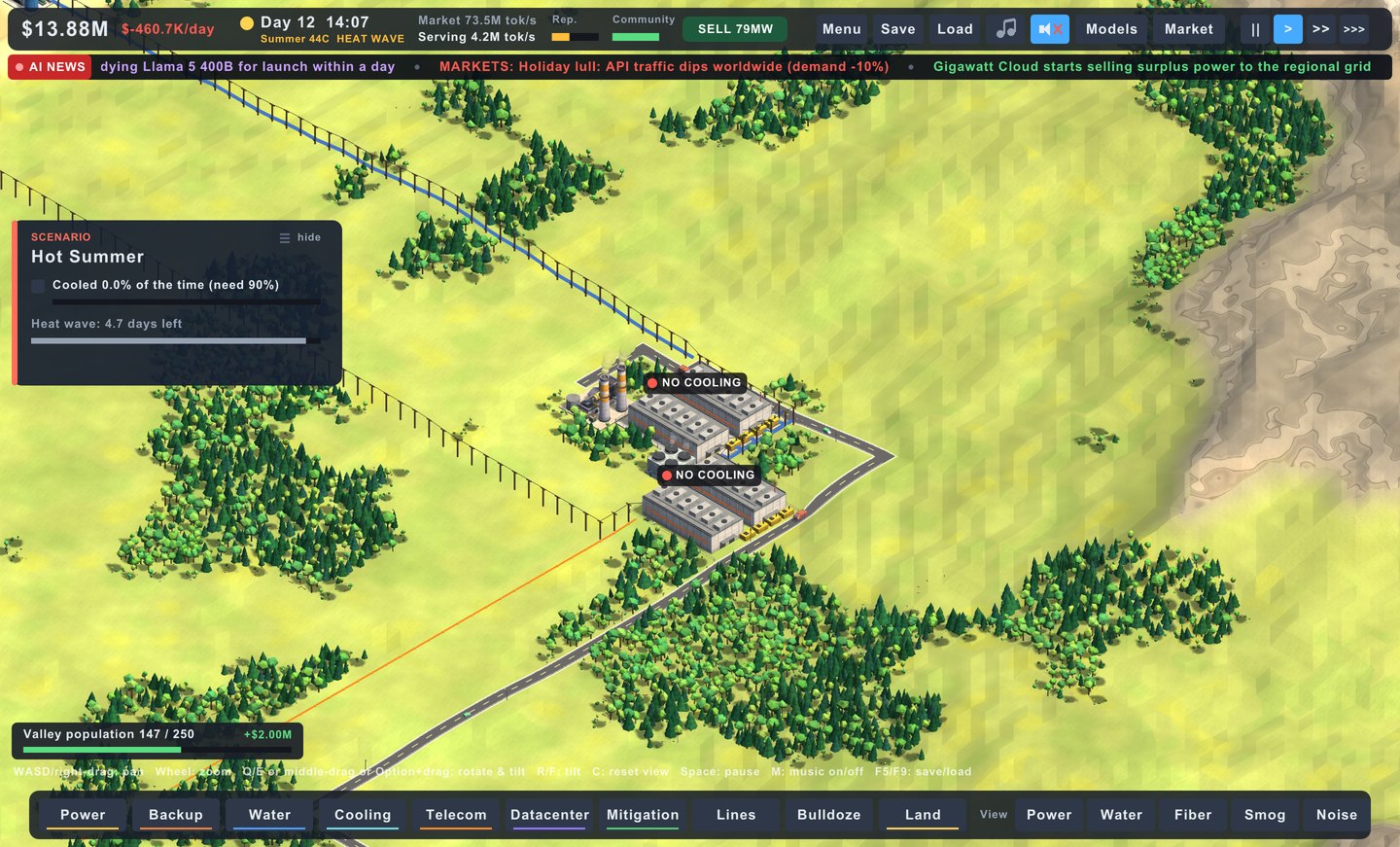
You earn money by serving tokens. License a model, deploy it on a datacenter's GPUs, and it serves its share of a market measured in millions of tokens a second. The models are real, with their parameter counts, GPU needs and prices.
- New releases are rumoured, then launch, and older models fade. Demand jumps and slumps with the news.
- Bandwidth is a hard cap: "Network 77%" means 77% of your traffic gets through.
- New GPU generations arrive. Refreshing a datacenter takes it offline for a day.
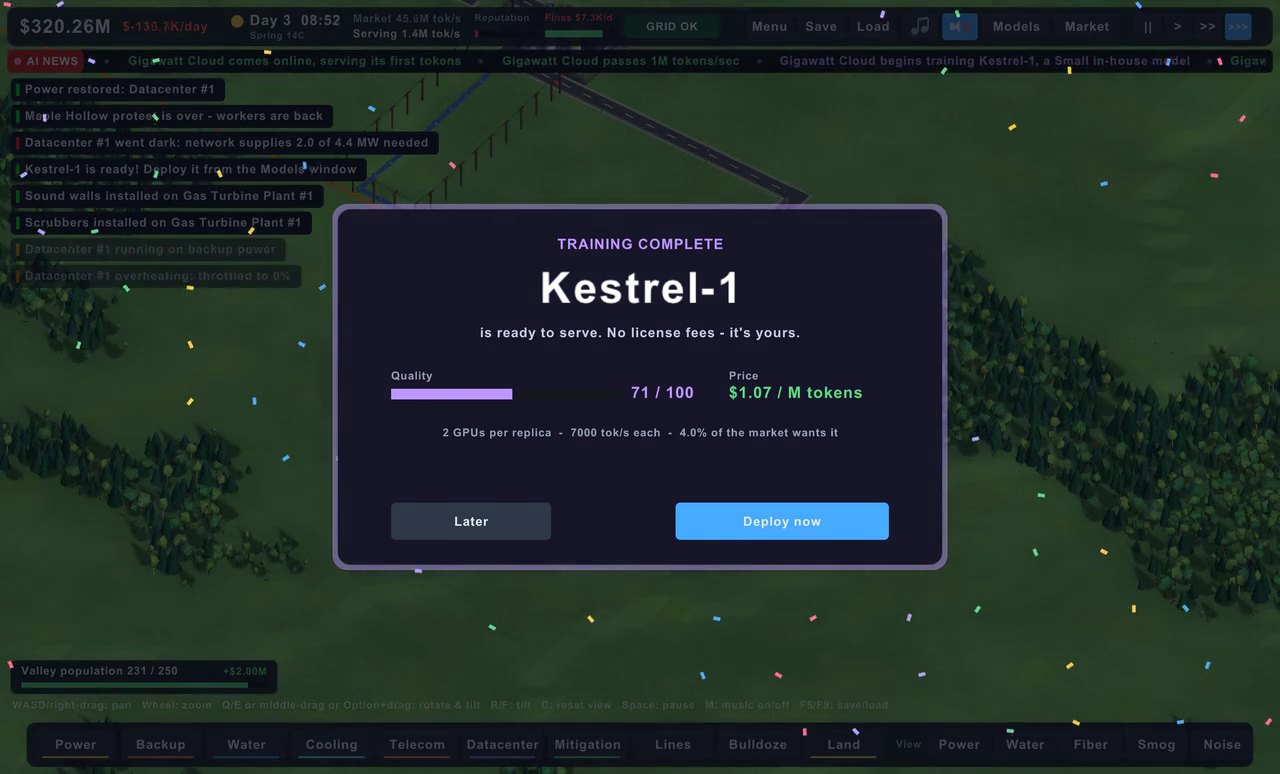
Train your own model
Commit thousands of GPUs for days, pay for the data, name the result, and you own a model that costs nothing to license. A Training Cluster does it twice as fast as a datacenter and needs no fiber, but it can't serve customers.
Villages, smog and protests
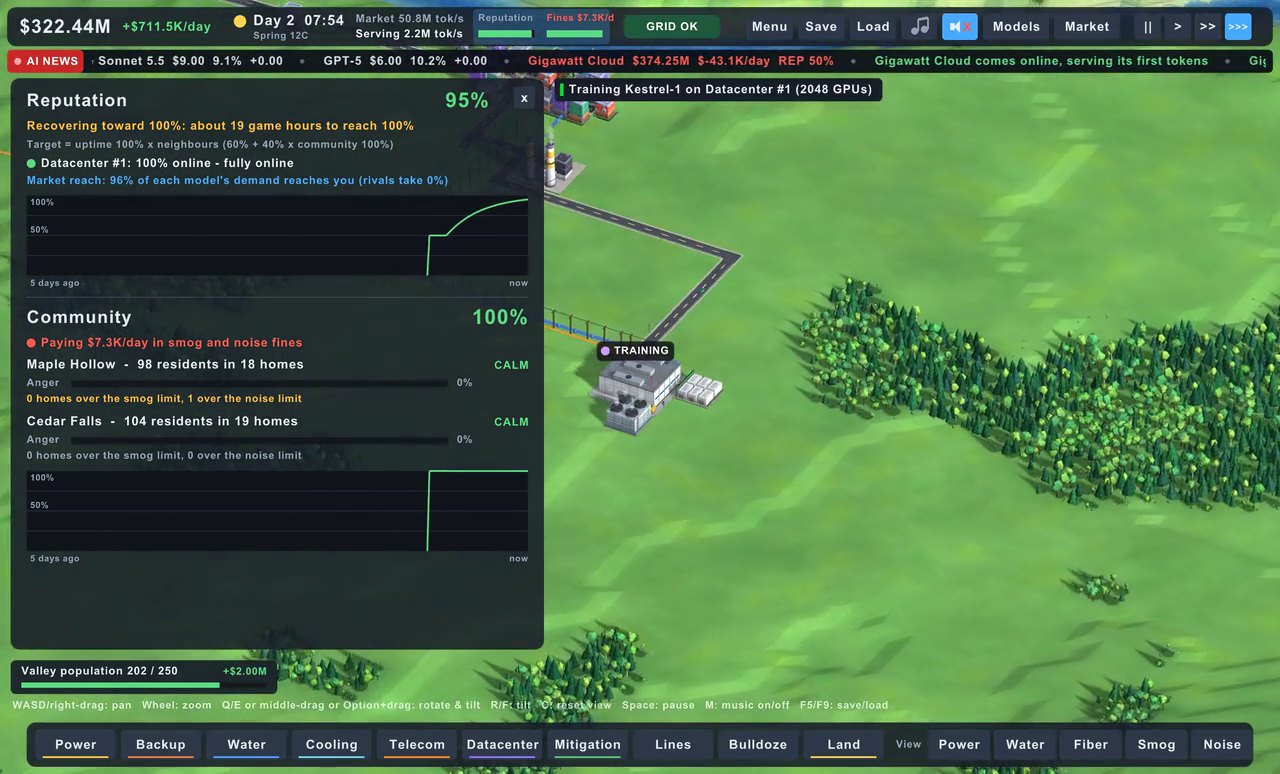
The valley's villages grow when there are jobs nearby and the air is clean. Gas plants and diesel generators make smog; turbines, chillers and cooling towers make noise. Both drift into the nearest homes.
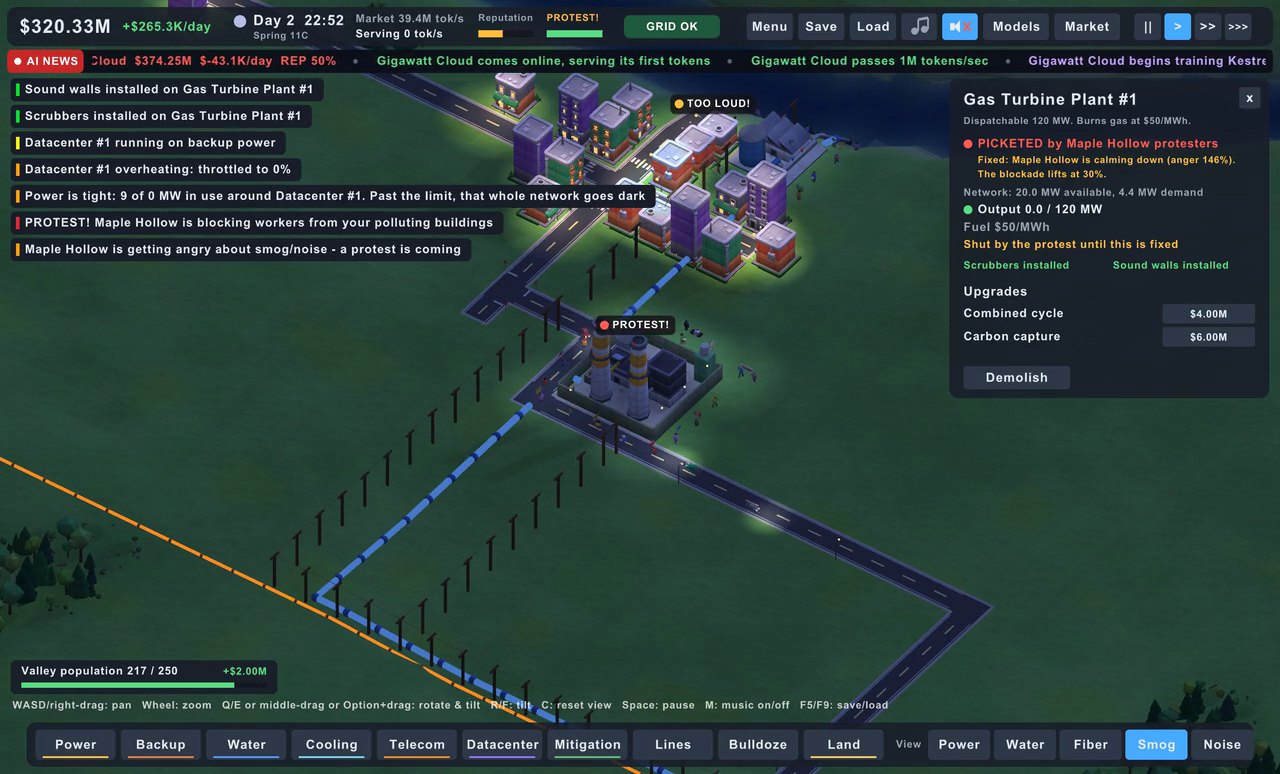
- First come complaints and daily fines. Then anger builds, and at 100% the village blockades the building.
- A blockade lasts until you fix the cause: fit scrubbers or sound walls, plant trees, or demolish it. The building's panel names what is wrong.
- Hit population goals and the village pays you a grant, and grows a downtown of shops, offices and towers.
Weather and seasons
The year turns through spring, summer, autumn and winter, and the valley shows it: trees turn and drop their leaves, snow lies on the ground, rain falls in a storm.
- Storms take down the regional grid and halve a satellite uplink.
- Heat waves cut what your cooling can remove.
- Droughts lower the river: pumps and the hydro dam give half.
- Cold snaps make heat reuse pay.
Rival clouds
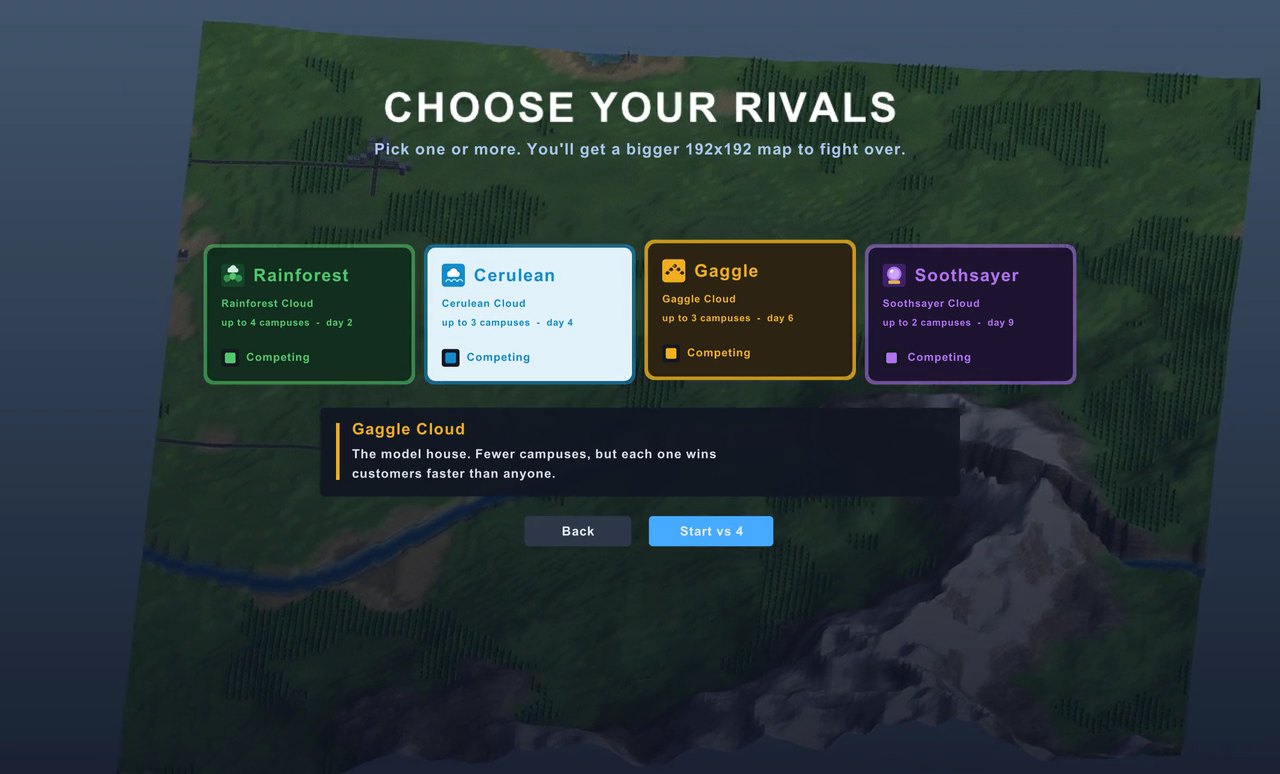
Play against Rainforest, Cerulean, Gaggle and Soothsayer Cloud and they open campuses across the valley. Each plays its own way: the fast builder, the price fighter, the model house and the late heavyweight. They take your customers whenever you go dark, and start price wars.
Upgrades
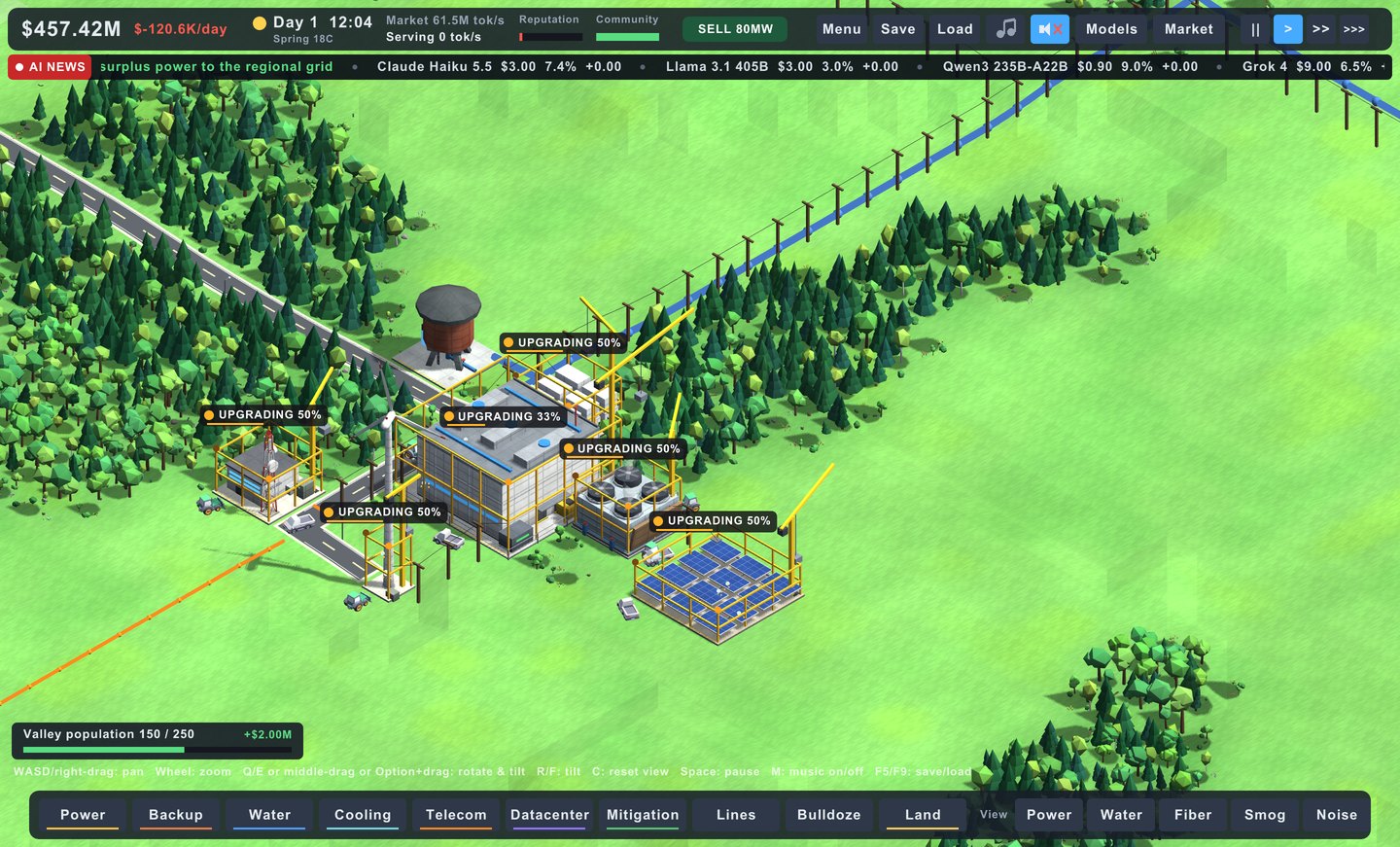
Most buildings can be upgraded. Crews arrive with scaffolding, a crane and flashing beacons, and every upgrade shows on the building.
| Upgrade | What it does |
|---|---|
| Liquid cooling | Direct-to-chip cooling: the halls dump 40% less heat into the water loop. Feynman GPUs need it. Offline 12 hours to fit. |
| Expansion wing | Another floor of racks: 50% more GPUs, drawing matching power, cooling and bandwidth. |
| UPS room | Flywheels and batteries hold the racks up through a power cut, so they come straight back with no 30-minute reboot. |
| Second fiber path | A diverse route for its fiber. When a storm or a backhoe cuts a line, traffic reroutes instead of dropping. |
| Combined cycle | A steam turbine on the exhaust heat: fuel cost falls from $50 to $33/MWh. |
| Carbon capture | Scrubs the flue gas: 70% less smog (on top of scrubbers), but it eats 15% of the plant's output. |
| Sun trackers | Panels follow the sun: much more output in the morning and evening. |
| Taller tower | A taller tower and longer blades: 40% more power, and 30% more noise. |
| Battery modules | Another row of cells: +20 MWh storage and +5 MW output each, up to three. |
| Recycling loop | Cleans and returns used water: +60 kL/h, and droughts can't touch the recycled flow. |
| Hybrid dry mode | Runs dry when it can: needs half the water, but loses twice as much capacity in hot weather. |
| Faster links | New optics: 400G doubles the hub's bandwidth, 800G quadruples it. |
Headquarters and research
Build one Headquarters and run research projects that improve the whole company.
| Project | What it does | Cost | Time |
|---|---|---|---|
| Power efficiency | Better power delivery and firmware: every GPU draws 10% less. | $8M | 2 days |
| Inference optimisation | Batching and speculative decoding: every datacenter serves 15% more tokens per second. | $15M | 3 days |
| Volume licensing | A licensing team negotiates bulk deals: model licences cost 30% less. | $5M | 1.5 days |
| Advanced cooling | Better heat exchangers and controls: cooling towers and air chillers remove 15% more heat. | $10M | 2 days |
| Grid trading desk | Traders time your exports to the market: surplus power sells for 15% more. | $6M | 1.5 days |
| Community outreach | A community team works with the villages: smog and noise fines are 40% lower. | $4M | 1.5 days |
| Training efficiency | Better data pipelines and checkpointing: training runs finish 30% faster. | $12M | 3 days |
| Chip partnerships | A partnership with the chipmakers: each new GPU generation reaches you 4 days early. | $25M | 4 days |
Land
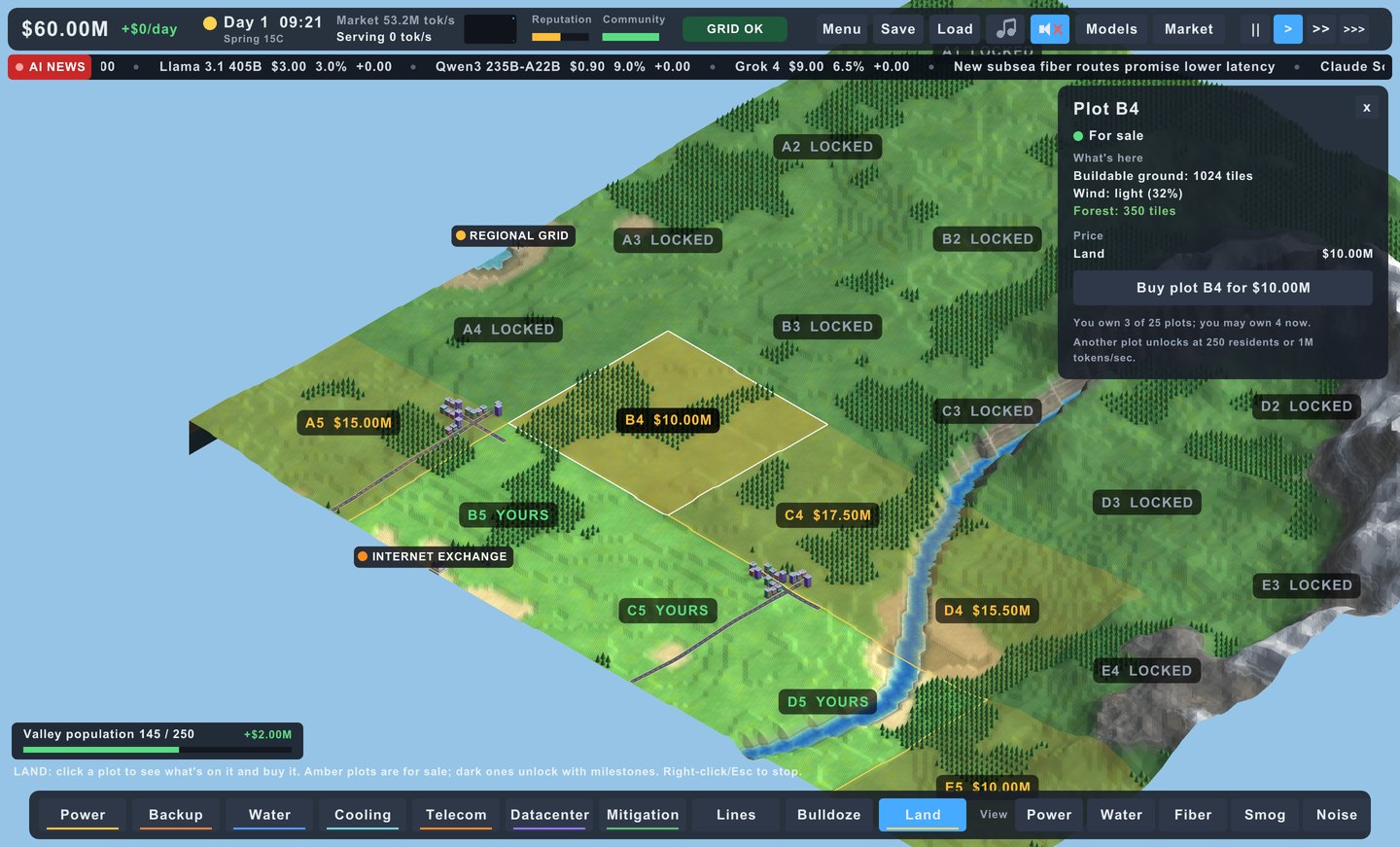
The valley is cut into plots: 25 on your own, 36 against rivals. You start with two and build only on land you own. Each plot for sale shows its river frontage, rock, wind and villages, and is priced on them. Level Ground flattens a hill for your next site.
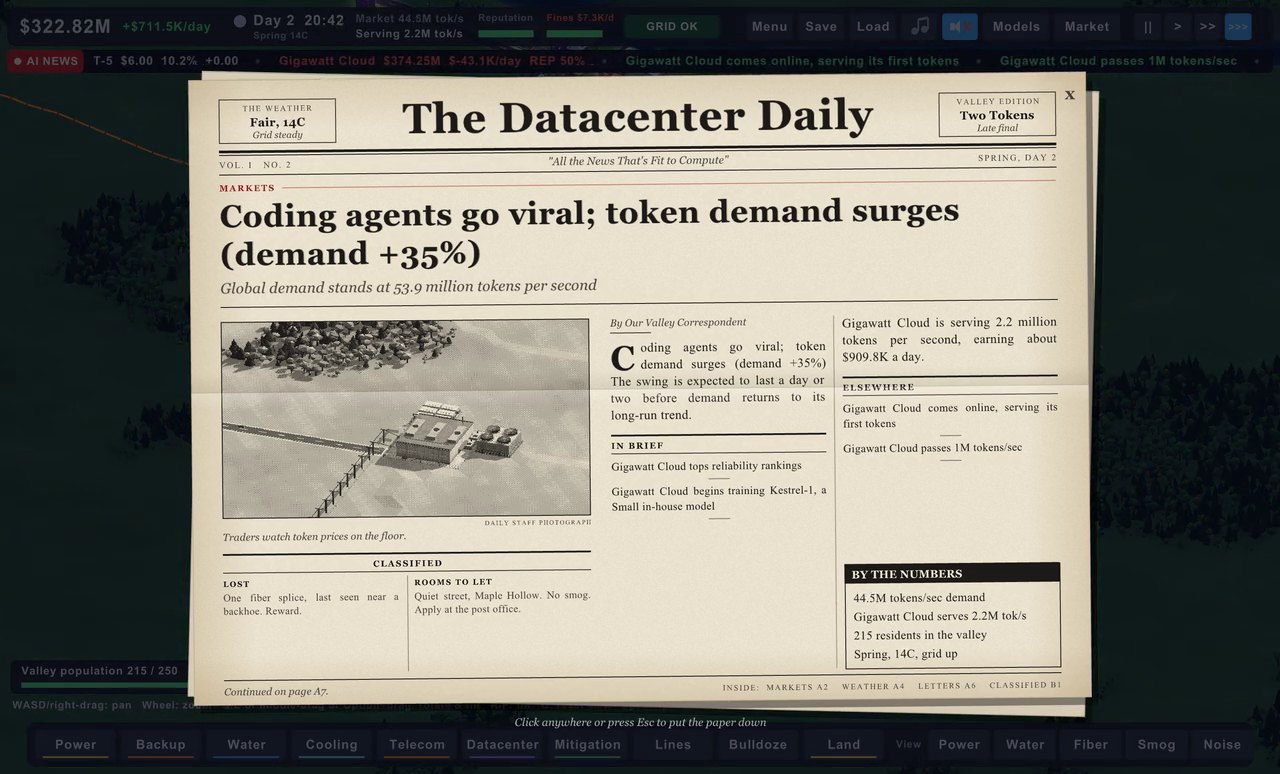
The Datacenter Daily
Every headline on the news ticker opens a front page of the valley's newspaper, written from your own game's numbers, with a newsprint photograph of the scene, the day's other stories in brief and a few classified notices.